




Interactive Game Room Trends: LED Floors and AR Integration — What Operators Need to Know
- Interactive Game Room Trends: LED Floors and AR Integration — Overview
- Why these trends matter now
- What is an Interactive LED Floor?
- Core components and capabilities
- What is AR Integration in Game Rooms?
- Types of AR used in commercial spaces
- Business Benefits: Why Combine LED Floors and AR?
- Design and Technical Considerations
- Space planning and flow
- Durability and maintenance
- Content and software
- Integration and interoperability
- Implementation Roadmap for Operators
- Cost, ROI and Revenue Models
- Comparison: LED Floors vs AR Integration
- Safety, Accessibility and Compliance
- Measurement: KPIs to Track Success
- How Kyda Supports LED Floor and AR Projects
- Typical Kyda engagement
- Future Outlook: Where the Trends Are
- Conclusion
- Frequently Asked Questions
Interactive Game Room Trends: LED Floors and AR Integration — Overview
Operators and designers searching for Interactive Game Room Trends: LED Floors and AR Integration are typically looking for commercial-grade, proven ways to increase visitor engagement, dwell time, and revenue. This article breaks down the two headline trends—interactive LED floors and augmented reality (AR) integration—explaining how they work, their business value, practical implementation steps, and how to choose the right solution for your location. We also highlight Kyda’s capabilities as a one-stop supplier for active game rooms and Activate gaming centers.
Why these trends matter now
Interactive attractions are evolving from single-purpose games to flexible experience platforms. LED floors offer immediate visual impact and multi-user play, while AR overlays enable contextual, story-driven gameplay without heavy physical remodeling. Together, they let operators deliver novel, repeatable experiences that appeal to families, teens, and corporate groups—key audiences for location-based entertainment venues.
What is an Interactive LED Floor?
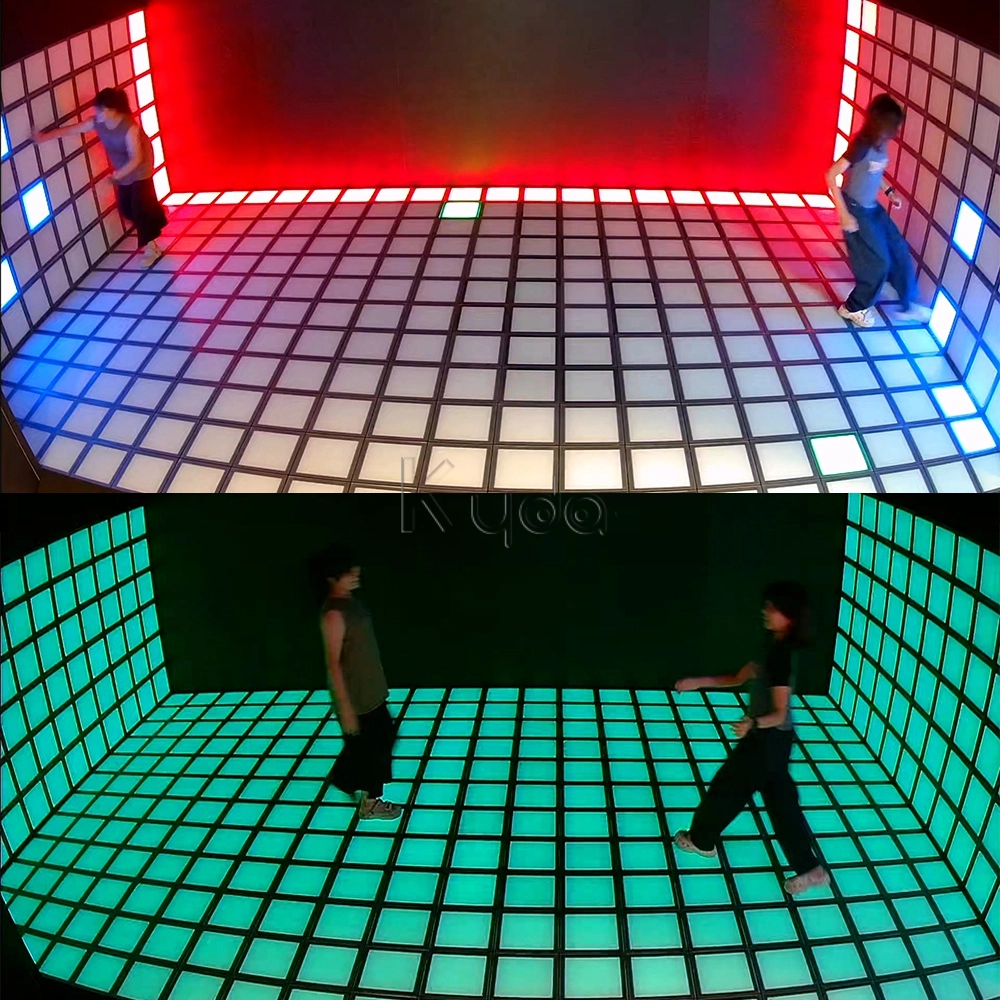
An interactive LED floor is a durable, sensor-enabled floor surface composed of LED panels or backlit tiles that respond to motion, touch, or game software. These systems can run games, branding loops, wayfinding, and themed visuals. Because they are modular and programmable, LED floors support rapid content changes to match promotions or events.
Core components and capabilities
- LED panels (IP-rated, load-bearing) with modular connectors
- Motion sensors, pressure sensors or camera-based tracking
- Content management software for playlists, game logic, and analytics
- Integration options with sound systems, lighting, and ticketing
What is AR Integration in Game Rooms?
AR integration adds virtual objects, characters, or UI elements to a real-world play area using screens, projectors, tablets, or headsets. For game rooms, AR can overlay challenges on physical sets, extend storytelling, or let multiple players interact with the same virtual objects in real time.
Types of AR used in commercial spaces
- Projection-based AR: projected graphics that align with physical surfaces
- Screen/tablet AR: handheld devices or kiosks that render AR views
- Wearable AR: lightweight headsets for fully immersive overlays
Business Benefits: Why Combine LED Floors and AR?
Combining LED floors and AR delivers layered, multi-sensory experiences. Below are the primary commercial benefits operators can expect.
- Higher dwell time: Dynamic, adaptive games increase session lengths and repeat visits.
- Flexible monetization: Pay-per-play, event rentals, branded experiences, and High Quality AR add-ons.
- Marketing impact: Visually striking LED floors paired with AR create social-media-ready moments, increasing organic reach.
- Operational versatility: Software-driven changes reduce the need for frequent physical renovations.
Design and Technical Considerations
Space planning and flow
Map traffic patterns and ensure play areas have clear ingress/egress. Consider sightlines for spectators and staff monitoring. LED floors perform best in defined zones (10–50 sqm typical per attraction) with clear boundaries for safety.
Durability and maintenance
Choose panels with commercial-grade load ratings and IP protection for cleaning. Plan maintenance access for module replacement. Kyda partners with regional manufacturers to provide robust, locally serviceable components.
Content and software
Content should be scalable: short-form casual games for walk-ins and deeper AR narratives for booked sessions. Opt for a CMS that supports remote updates, usage analytics, and multi-language content to maximize uptime and adapt to seasonal campaigns.
Integration and interoperability
Ensure LED floors and AR subsystems share a common protocol or have middleware. Integrations with POS, CRM, or booking engines enable upsell opportunities and performance tracking.
Implementation Roadmap for Operators
- Define goals: increase revenue, boost visits, improve social sharing, or host events.
- Conduct a site audit: power, load-bearing floor, Wi-Fi coverage, sightlines.
- Choose hardware profile: LED-only, AR-only, or hybrid.
- Prototype and pilot: start with a single modular zone and test user flows.
- Scale and iterate: expand content, integrate analytics, and train staff.
Cost, ROI and Revenue Models
Costs vary by size, hardware quality, and content complexity. A cost-effective approach is modular deployment—start with one LED zone and add AR features over time. Revenue models include pay-per-play, time-based sessions, memberships, private bookings, brand partnerships, and in-app purchases for AR experiences.
Comparison: LED Floors vs AR Integration
| Metric | Interactive LED Floors | AR Integration |
|---|---|---|
| Visual Impact | High immediately; strong social-media appeal | High when combined with physical sets or wearables |
| Scalability | Modular expansion; requires floor real estate | Scales via content and devices; less physical footprint |
| Maintenance | Hardware wear; panel replacements needed | Software updates and device lifecycle management |
| Best for | Arcades, family entertainment centers, malls | Themed experiences, escape rooms, education centers |
| Visitor Interaction | Physical, multi-user, spectator-friendly | Immersive, narrative-driven, personalized |
Safety, Accessibility and Compliance
Follow local building codes, accessibility standards (e.g., ADA considerations in the U.S.), and electrical regulations. Provide clear signage, anti-slip surfaces, and staff supervision. For AR wearables, ensure hygiene and offer non-wearable alternatives for guests with sensory sensitivities.
Measurement: KPIs to Track Success
- Average dwell time per session
- Repeat visitation rate
- Revenue per square meter
- Conversion of walk-ins to paid sessions
- Social shares and earned media impressions
How Kyda Supports LED Floor and AR Projects
Kyda is a one-stop solution provider focused on active interactive games, LED floor systems, and AR-enabled attractions. Our multidisciplinary team covers electronic design, software programming, game and animation design, and interior design. Leveraging manufacturing partnerships across Guangzhou, Zhongshan, Zhengzhou, and Beijing, Kyda builds customizable, locally serviceable solutions—ideal for operators seeking quick deployment and high return on investment.
Typical Kyda engagement
- Consultation and goals alignment
- Site evaluation and feasibility study
- Custom design, prototyping and pilot
- Manufacturing and local installation
- Training, content packages and ongoing support
Future Outlook: Where the Trends Are
Expect tighter fusion between physical surfaces and AI-driven AR content. Advances in lightweight AR wearables and edge computing will reduce latency and improve multi-user synchronization. Modular LED systems will increasingly support IoT telemetry, enabling predictive maintenance and dynamic pricing strategies tied to live analytics.
Conclusion
For operators searching Interactive Game Room Trends: LED Floors and AR Integration, the strategic takeaway is clear: combining modular LED floors with purposeful AR content creates highly engaging, revenue-generating attractions that are adaptable to changing customer tastes. Start small, measure the right KPIs, and choose partners—like Kyda—that provide end-to-end capabilities from hardware to content and operations. This approach minimizes risk, accelerates time-to-market, and maximizes long-term returns.
Frequently Asked Questions
What are the main differences between an LED floor and AR experiences?An LED floor is a physical, durable surface that displays visuals and responds to motion; it offers immediate visual impact and multi-user play. AR overlays virtual content on the real world via projectors, screens, tablets, or headsets and supports deeper narrative and personalized interactions.
How long does it take to install an LED floor or AR attraction?Small modular LED zones or a basic AR kiosk can be piloted in weeks; a fully integrated hybrid attraction typically requires 8–16 weeks including design, manufacturing, testing, and staff training. Timelines depend on site readiness and local approvals.
What are realistic KPIs for an interactive attraction?Target increases include +20–50% dwell time per guest, higher conversion of walk-ins to paid sessions, and measurable uplift in social shares. Exact KPIs vary by location and offering.
How should I budget for maintenance and software updates?Budget for routine cleaning, spare LED modules, and annual software support. Include remote update capability and service contracts with local partners to minimize downtime.
Can AR and LED floors be used for branded events or corporate bookings?Yes—both solutions are ideal for branded activations, team-building events, and private bookings because content can be quickly customized and deployed.
Are these technologies safe for children and people with disabilities?When designed correctly, yes. Follow local safety codes, incorporate anti-slip surfaces, provide clear instructions, and offer alternatives to wearable AR for users with disabilities or sensory sensitivities.
How can Kyda help with a project?Kyda offers end-to-end services: consultation, custom R&D, hardware manufacturing, content creation, installation, and after-sales support. Our regional partnerships enable cost-effective, customizable projects tailored to local markets.
How to Choose the floor lights game manufacturer and supplier in us?
Creating Multiplayer Interactive Wall Projection Experiences: A Practical Guide for Activate Gaming Centers
How to create custom games for LED interactive game floors
How to Choose the activate game manufacturer and supplier in us?
You May Also Like
-
-
Send us Your Inquiry
-
Fill out the form and we will provide you with personalized product quotes and service recommendations based on your needs.
Our team will contact you as soon as possible to help you build the most suitable entertainment equipment!
Let's get in touch
Email: sales@kydavr.com
Tel.: +86 188 2001 8779
Address: 501 Shixin Road, Dalong Street, Guangzhou, Guangdong, China.
© 2025 Kyda. All Rights Reserved.
 Scan QR Code
Linkedin
Ins
Facebook
Twitter
YouTube