


Why Businesses Are Investing in Active Game Room Equipment to Increase Visitor Engagement and Revenue
- Why Interactive Activity Zones Are Becoming Commercial Growth Assets
- Participation increases dwell time and revenue opportunities
- Immersive technology supports differentiated venue positioning
- Active play aligns with wellness and social engagement trends
- How Active Game Room Projects Generate a Defensible Return
- Throughput is more important than headline attraction price
- Repeatability creates customer lifetime value
- Operational efficiency protects margins
- Procurement Criteria for a Reliable Interactive Entertainment Installation
- Match the technology to the venue and audience
- Verify engineering, compliance, and quality control
- Assess the supplier’s ability to deliver a complete project
- Why Kyda Is a Practical Partner for Customized Active Game Rooms
- One-stop product and project development
- Cross-disciplinary engineering and customization
- Manufacturing resources and long-term project support
- Frequently Asked Questions
- What types of businesses benefit most from active game room equipment?
- How can an operator estimate the return on investment?
- Are interactive projection games suitable for small venues?
- What should buyers request from an equipment manufacturer?
- Can active game room equipment be customized for branding or education?
- Why is supplier support important after installation?
Businesses are investing in active game room equipment because interactive attractions transform passive visitors into participants, extend dwell time, encourage social sharing, and create more opportunities for admissions, memberships, food and beverage sales, merchandise, parties, and repeat visits. Interactive projection games, interactive LED floors, interactive LED walls, laser interactive games, reaction challenges, and active fitness systems are especially relevant to family entertainment centers, shopping malls, resorts, museums, schools, hotels, trampoline parks, and mixed-use leisure venues. For buyers searching for an active game room equipment supplier china, the key decision is not simply which machine looks impressive; it is which integrated attraction can deliver reliable throughput, safe operation, flexible content, manageable maintenance, and a credible return on invested capital. This article examines the commercial drivers, procurement criteria, performance planning, and customization options behind activate interactive games, with practical guidance for project owners and distributors.
Why Interactive Activity Zones Are Becoming Commercial Growth Assets
Participation increases dwell time and revenue opportunities
Traditional entertainment formats often depend on a single viewing cycle or a fixed game session. Active game rooms create a participation loop: visitors enter, understand the objective, play, compete, share the experience, and often return to improve their score. That loop gives operators more ways to structure admission packages, timed sessions, all-day passes, birthday programs, corporate events, and loyalty incentives.
Longer visits can also support secondary revenue. A family that spends additional time in a venue has more opportunities to purchase refreshments, upgrade its package, book another attraction, or recommend the destination to others. The commercial benefit is not guaranteed by hardware alone, but well-designed activity zones make cross-selling more natural because the entertainment experience is social, repeatable, and easy to package.
Immersive technology supports differentiated venue positioning
Interactive environments help operators compete against home gaming, conventional arcades, and other local attractions. A responsive floor, wall, projection surface, or sensor-based challenge provides a physical experience that cannot be replicated fully on a personal screen. This distinction is valuable for venues seeking a clear identity, particularly where several entertainment businesses compete within the same retail or tourism district.
Content variety is equally important. A venue can use the same physical installation for sports, education, music, reflex training, adventure, children’s play, seasonal campaigns, and branded events. This flexibility reduces dependence on one age group or one popular title and helps the operator refresh the customer experience without replacing the entire installation.
Active play aligns with wellness and social engagement trends
Active attractions can encourage movement, coordination, problem-solving, and face-to-face interaction. The World Health Organization physical activity guidelines recognize the importance of regular physical activity across age groups, although an entertainment product should not be marketed as a medical treatment or a substitute for professional exercise advice. For operators, the practical opportunity is to position movement-based games as enjoyable recreation that supports family participation and group interaction.
Design teams should still consider accessibility, user fatigue, age suitability, floor conditions, lighting, sound levels, and supervision. Inclusive game modes, adjustable difficulty, clear instructions, and adequate circulation can widen the customer base while reducing operational friction.
How Active Game Room Projects Generate a Defensible Return
Throughput is more important than headline attraction price
Revenue planning begins with capacity. Buyers should calculate the number of players per cycle, average session duration, reset time, operating hours, expected utilization, ticket price, and peak-period demand. A visually impressive system with low capacity may generate less revenue than a modular attraction that serves several players continuously.
A basic planning formula is: estimated attraction revenue equals player capacity multiplied by operating cycles, utilization rate, operating days, and average revenue per player. This is a planning model rather than a market guarantee. It should be tested against local pricing, rent, staffing, taxes, payment fees, maintenance, content licensing, utilities, and seasonal demand.
| Planning factor | Conventional fixed-play attraction | Interactive active-play zone | Commercial implication |
|---|---|---|---|
| Content flexibility | Usually limited to one core experience | Can support multiple game modes and themes | Creates more campaign and repeat-visit options |
| Player participation | Often individual or observation-based | Frequently supports group play and competition | Improves suitability for parties and events |
| Space planning | Defined by a fixed cabinet or ride footprint | Can be configured across floors, walls, rooms, or zones | Allows better adaptation to irregular premises |
| Refresh strategy | May require hardware replacement | Often combines existing hardware with software or content updates | Potentially lowers the cost of seasonal refreshes |
| Operational risks | Mechanical wear or queue bottlenecks | Calibration, sensors, projectors, displays, and software support | Requires preventive maintenance and technical training |
The comparison above is a strategic framework, not a universal performance benchmark. Actual results depend on local market conditions and equipment specifications. Buyers should request a financial model based on their floor plan and verify the assumptions through a site survey or pilot installation.
Repeatability creates customer lifetime value
Repeat visits are more likely when games offer levels, scores, challenges, leaderboards, team play, rotating content, or progressive difficulty. Operators should ask whether the platform supports content updates, multilingual interfaces, remote diagnostics, user profiles, and event modes. These functions can turn a one-time attraction into an ongoing program.
For family venues, different difficulty settings allow children and adults to play together. For corporate entertainment, timed competitions and scoreboards can support team-building events. For educational facilities, interactive projection games can be linked to movement, memory, mathematics, geography, or science themes. A supplier that understands these use cases can help the buyer purchase a business platform rather than a decorative installation.
Operational efficiency protects margins
Labor and downtime frequently have a greater effect on profitability than the initial equipment price. A project owner should examine startup procedures, cleaning access, replacement parts, remote support, fault reporting, operator training, warranty terms, and expected service intervals. Systems should be designed so that front-line staff can perform basic resets and calibration without exposing sensitive components or waiting for a technician for every minor issue.
Electrical load, ventilation, ambient light, acoustics, network requirements, and spare-part availability also belong in the procurement specification. ISO 9241-210 provides a recognized framework for human-centred design, and its principles are relevant when teams evaluate usability, instructions, interaction flow, and the relationship between users and technology. It does not certify a specific amusement product, so project owners should also complete their own safety and compliance review.
Procurement Criteria for a Reliable Interactive Entertainment Installation
Match the technology to the venue and audience
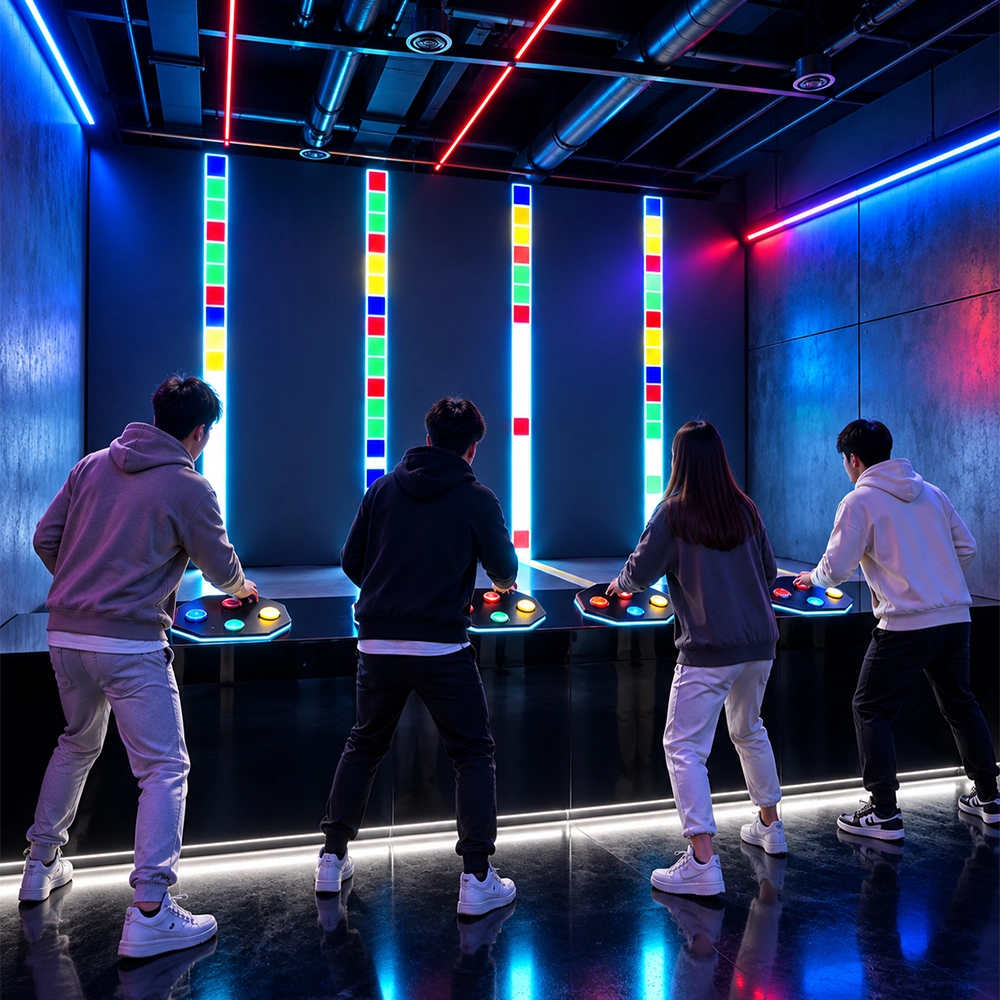
Interactive projection games are effective where open floor space, controlled lighting, and flexible themes are available. An interactive LED floor or interactive LED wall can provide strong visual impact in high-traffic areas, while active reaction games and laser interactive game systems are suitable for competitive play and short sessions. Brain challenge games can support schools, museums, and family venues that want cognitive interaction alongside physical activity.
Buyers should define the user journey before selecting products. The specification should state the target age range, number of simultaneous players, session length, queue design, room dimensions, ceiling height, lighting conditions, sound policy, accessibility requirements, expected daily usage, and future content needs. This prevents the common mistake of buying a visually attractive product that does not fit the actual traffic pattern.
Verify engineering, compliance, and quality control
A credible supplier should provide technical drawings, electrical specifications, installation requirements, packing details, warranty conditions, spare-part recommendations, and a documented testing process. Buyers should request evidence of relevant certifications for the destination market rather than assuming that a general factory certificate covers the complete installation. Electrical safety, electromagnetic compatibility, fire requirements, structural stability, flooring, trip hazards, and emergency access should be reviewed with local professionals.
Where products include software, the contract should clarify ownership or usage rights, update responsibilities, data handling, remote access, language support, and what happens if a third-party component becomes unavailable. The IEEE 7000 standard offers a reference point for addressing ethical concerns during system design; it is not a replacement for local privacy, cybersecurity, or consumer-protection obligations.
Assess the supplier’s ability to deliver a complete project
Complex active game rooms involve more than individual products. They may require spatial planning, custom housings, LED integration, projection alignment, animation, software configuration, signage, theming, installation coordination, and staff training. A one-stop provider can reduce communication gaps between separate contractors, but the buyer should still request a clear responsibility matrix and milestone schedule.
Before issuing a purchase order, compare sample drawings, prototype approval procedures, factory acceptance testing, packaging protection, installation supervision, after-sales response times, and replacement-part lead times. Solution planning should connect the attraction mix to the venue’s commercial goals rather than treating each machine as an isolated purchase.
Why Kyda Is a Practical Partner for Customized Active Game Rooms
One-stop product and project development
Kyda is a one-stop solution provider for active game rooms and Activate gaming centers, supporting custom research, development, production, and sales of interactive and educational recreational products, indoor and outdoor amusement equipment, and low-cost, high-income, high-return equipment. Our portfolio includes active interactive games, interactive LED floor systems, active reaction games, brain challenge games, horror escape games, active fitness games, interactive projection games, and other thrilling amusement equipment.
Our product approach is designed for buyers who need a coordinated attraction mix rather than a single standard machine. Interactive projection games can be developed for movement, competition, education, or themed entertainment. Interactive LED floors and interactive LED walls can strengthen visual identity in reception areas, central play zones, and event spaces. Laser interactive game formats and active reaction games can add fast-cycle competition for teenagers, families, and corporate groups.
Cross-disciplinary engineering and customization
Our team includes professionals in electronic design and development, software programming, game design, animation design, product design, multimedia design, and interior design. This combination helps connect hardware behavior, visual content, user flow, room aesthetics, and operational requirements during the project development process.
Customization may include game rules, languages, branding, cabinet dimensions, sensor configuration, room layout, difficulty levels, scoring logic, visual themes, and integration with the venue’s customer journey. We encourage buyers to provide a floor plan, target audience profile, operating model, local compliance requirements, and preferred delivery schedule so that the proposed configuration can be evaluated against real project constraints.
Manufacturing resources and long-term project support
Our manufacturing network leverages the advantages of Guangzhou, Zhongshan, Zhengzhou, and Beijing. We maintain long-term partnerships with LED light factories, advertising production factories, sheet metal factories, paint factories, electronic assembly factories, 3D plastic printing factories, and multimedia resource companies. These relationships support customized products and complete projects for different local market needs.
Our process is built around evolving technology, design capability, execution quality, and personalized customization. We aim to help investors, distributors, brand owners, and facility operators manage product selection, appearance, technical integration, production coordination, and delivery with fewer fragmented interfaces. Kyda’s vision is to become the world’s leading active game room manufacturer, while maintaining a practical focus on reliability, serviceability, and commercial value.
For additional context on human movement and health-related claims, buyers can review the WHO physical activity fact sheet. Entertainment equipment should be positioned accurately: it can encourage active participation, but it should not be presented as a medical device or guaranteed health intervention.
Frequently Asked Questions
What types of businesses benefit most from active game room equipment?
Family entertainment centers, shopping malls, resorts, hotels, museums, schools, trampoline parks, sports facilities, and corporate event venues can benefit when the attraction matches their audience, available space, staffing model, and pricing strategy. The strongest projects define the customer journey and revenue model before selecting equipment.
How can an operator estimate the return on investment?
Operators should model capacity, session duration, reset time, utilization, operating days, ticket price, group bookings, secondary spending, staffing, rent, utilities, maintenance, content updates, and marketing costs. The result should be tested against conservative, expected, and peak scenarios rather than relying on a supplier’s best-case estimate.
Are interactive projection games suitable for small venues?
They can be suitable when the projection area, ceiling height, lighting, circulation, and player capacity are planned correctly. Smaller venues may use compact configurations, short-cycle games, wall-based interaction, or modular content, but a site survey is important to confirm image quality and safe movement space.
What should buyers request from an equipment manufacturer?
Buyers should request technical drawings, electrical data, installation requirements, testing records, warranty terms, spare-part information, software and content terms, training details, packing specifications, delivery milestones, and after-sales response procedures. Destination-market compliance should be verified separately with qualified local professionals.
Can active game room equipment be customized for branding or education?
Yes. Depending on the platform, customization may include visual themes, branded content, language options, game rules, difficulty settings, room decoration, scoring systems, and educational subjects. The scope should be documented during design approval so that the budget and delivery schedule remain clear.
Why is supplier support important after installation?
Ongoing support helps operators manage calibration, software updates, replacement parts, staff training, troubleshooting, and preventive maintenance. Fast support can reduce downtime and protect the visitor experience, especially in venues that operate every day or depend on seasonal peaks.
Contact Kyda at sales@kydavr.com or visit https://www.kydagames.com to discuss a customized active game room, review interactive products, and plan a revenue-focused entertainment installation.
Cost breakdown: Installing an LED interactive game floor
Top 10 indoor active games Manufacturers and Supplier Brands in us
Interactive Wall Projection Games for Museums and Exhibits: Design, ROI, and Best Practices
What Are Interactive Wall Projection Games? A Beginner's Guide
You May Also Like


-
-
Send us Your Inquiry
-
Fill out the form and we will provide you with personalized product quotes and service recommendations based on your needs.
Our team will contact you as soon as possible to help you build the most suitable entertainment equipment!
Let's get in touch
Email: sales@kydavr.com
Tel.: +86 188 2001 8779
Address: 501 Shixin Road, Dalong Street, Guangzhou, Guangdong, China.
© 2025 Kyda. All Rights Reserved.
 Scan QR Code
Linkedin
Ins
Facebook
Twitter
YouTube