


What Types of Interactive Game Room Equipment Are Available for Indoor Venues?
- Interactive Entertainment Systems for Modern Indoor Venues
- Projection-based attractions and immersive play zones
- Interactive LED floors and walls
- Laser, sensor, and reaction-based game equipment
- Equipment Categories and Procurement Considerations
- Active fitness, sports, and coordination attractions
- Brain challenge, educational, and cooperative games
- Escape rooms, horror experiences, and narrative attractions
- How to Build a Commercially Viable Activate Interactive Games Venue
- Match the attraction mix to the revenue model
- Control safety, accessibility, and operational risk
- Specify serviceability and content continuity
- Why Kyda Is a Practical Partner for Interactive Game Room Projects
- One-stop development, manufacturing, and project support
- Multidisciplinary engineering and content capabilities
- Manufacturing network and customization advantages
- Frequently Asked Questions
Indoor venues can choose from interactive projection games, interactive LED floors, interactive LED walls, laser interactive game systems, active reaction attractions, brain challenge stations, fitness-oriented experiences, horror escape technology, and multimedia amusement equipment. Selection should be based on available floor area, ceiling height, expected capacity, age range, session duration, cleaning requirements, accessibility, software scalability, maintenance access, and revenue model. A reliable project plan connects each attraction to a clear operating purpose: increasing dwell time, encouraging repeat visits, supporting group bookings, creating family-friendly participation, or differentiating an Activate gaming center from conventional entertainment venues. Buyers should evaluate not only visual impact but also hardware durability, sensor accuracy, content refresh options, installation complexity, staff training, spare-parts availability, and total cost of ownership. For a broader project overview, buyers can review the solutions available for complete interactive entertainment environments.
Interactive Entertainment Systems for Modern Indoor Venues
Projection-based attractions and immersive play zones
Interactive projection games use projectors, motion sensors, cameras, media servers, and specially designed software to turn floors, walls, tables, or scenic surfaces into responsive play areas. Participants may step on virtual targets, avoid obstacles, collect digital objects, answer questions, or cooperate in team challenges. This category is highly adaptable because content can be changed without replacing the entire physical installation. It is suitable for family entertainment centers, museums, education venues, shopping malls, resorts, and corporate team-building spaces.
Procurement teams should examine projector brightness, resolution, throw distance, ambient-light performance, calibration procedures, sensor field of view, and replacement costs. A visually impressive system can underperform if sunlight, reflective flooring, low ceilings, or crowded play zones interfere with tracking. Software should support multiple difficulty levels, multilingual interfaces, session timers, attract-mode content, and operator controls. The most commercially useful installations offer a content library and a defined process for adding new games during seasonal campaigns.
Interactive LED floors and walls
An interactive LED floor combines modular LED tiles with pressure sensing, infrared detection, or computer-vision technology. The system can respond when visitors walk, jump, chase, or stand on illuminated areas. LED floors are effective for high-energy play because they provide strong visual feedback and remain visible in venues where projection contrast may be limited. They can serve as standalone attractions or as part of a larger active game room containing music, lighting, scoring, and competitive challenges.
An interactive LED wall extends the same principle vertically. It can display responsive games, sports simulations, branded content, educational challenges, or multiplayer reaction tasks. Buyers should confirm pixel protection, load-bearing specifications, anti-slip treatment, tile replacement procedures, ventilation, cable routing, and access to control electronics. Modular construction is particularly important because a damaged tile should be replaceable without dismantling an entire wall or floor. The design should also preserve clear evacuation paths and prevent exposed edges from creating trip hazards.
Laser, sensor, and reaction-based game equipment
Laser interactive game systems use safe, low-power light emitters or infrared tagging technology with targets, wearable devices, sensors, and scoring software. They may be configured as timed reaction games, competitive target challenges, tactical team play, or obstacle-based missions. These attractions appeal to teenagers, adults, corporate groups, and customers seeking a more competitive format than casual projection play.
Technical evaluation should distinguish between visible laser effects and infrared tracking, because the safety controls, calibration process, and operating procedures can differ. Suppliers should provide clear technical documentation, protective housing, emergency stop functions where applicable, maintenance instructions, and compliance information for the destination market. The IEC 62368-1 standard is a relevant reference for audio/video, information, and communication technology equipment safety, although buyers must also confirm local electrical, building, fire, and amusement requirements.
Equipment Categories and Procurement Considerations
Active fitness, sports, and coordination attractions
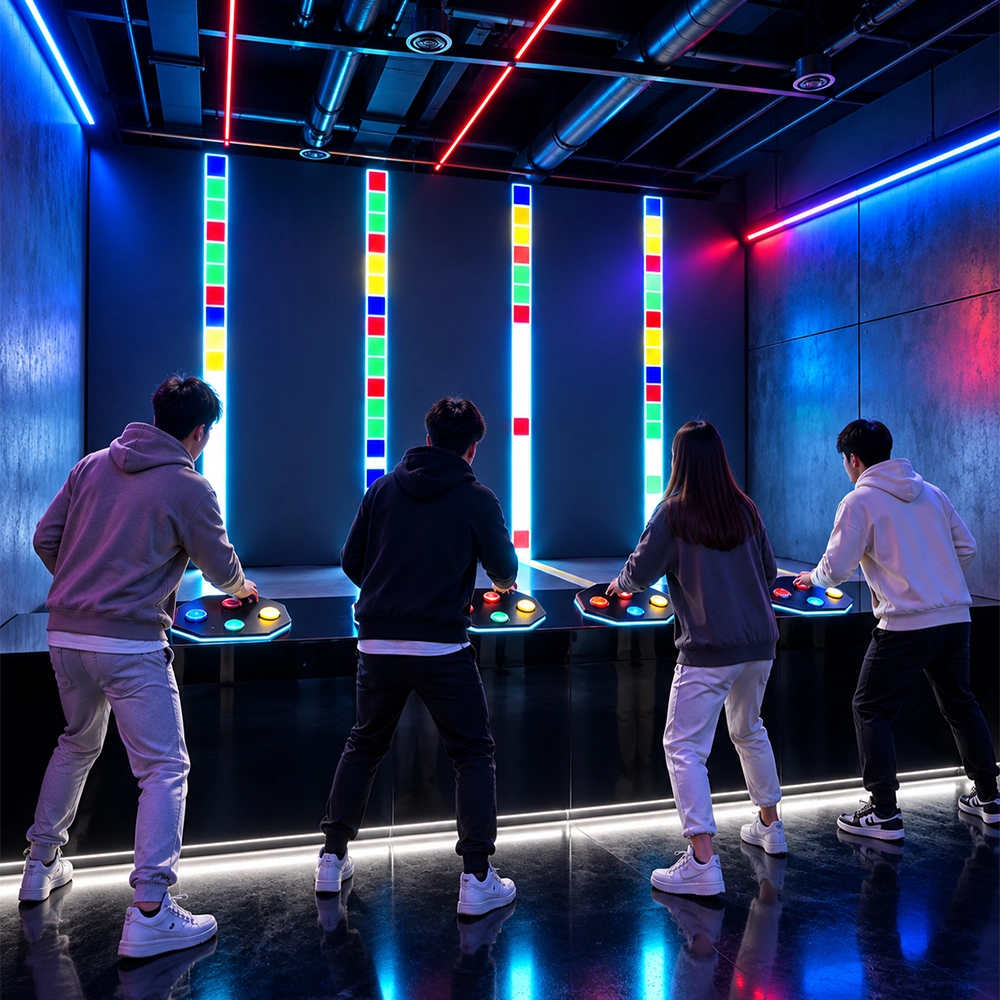
Active fitness games convert physical movement into a measurable digital challenge. Common formats include virtual sports, dance and rhythm activities, stepping games, agility tests, reaction walls, cycling simulations, and cooperative movement tasks. They help venues serve customers who want entertainment with a physical component and can support school programs, wellness campaigns, family recreation, and corporate events.
Commercial buyers should assess the intensity range, floor impact, cleaning protocol, user weight limits, ventilation, and reset time between sessions. Equipment must communicate instructions quickly so that first-time users do not require constant staff intervention. A strong product also provides visible scoring, short learning curves, adjustable difficulty, and a clear distinction between competitive play and casual participation. Where children are expected, rounded edges, stable handholds, slip resistance, and age-appropriate movement requirements should be part of the design brief.
Brain challenge, educational, and cooperative games
Brain challenge equipment uses logic, memory, pattern recognition, problem-solving, and communication tasks to create engagement without relying solely on physical speed. These attractions are valuable in mixed-age venues because they can include children, parents, older visitors, and participants with different physical abilities. Educational recreational products can be aligned with mathematics, science, language learning, history, or spatial reasoning while retaining a game-like interface.
For buyers, the key issue is content depth. A single puzzle may attract initial attention but generate limited repeat visits. Better systems offer multiple levels, randomized challenges, team modes, performance tracking, and content updates. Interfaces should use readable typography, intuitive icons, adjustable audio, and clear instructions. The ISO 9241-210 human-centred design guidance provides a useful framework for considering users, tasks, environments, and iterative improvement during product and venue development.
Escape rooms, horror experiences, and narrative attractions
Horror escape games and narrative rooms combine physical scenery, puzzles, lighting, sound, sensors, triggers, projection, and scripted events. Compared with open-play attractions, they require stronger story design, controlled capacity, timed sessions, reset workflows, and staff procedures. Their commercial advantage is a higher perceived event value and a natural fit for reservations, group packages, seasonal promotions, and repeatable themed content.
Project owners should map every participant route, emergency exit, staff access point, reset action, and potential failure state before construction. Sound levels, darkness, startle effects, fog, confined areas, and moving scenic elements require careful risk assessment. Operators should publish age guidance and accessibility information rather than relying on the novelty of the theme. The ADA guidance for accessible facilities and services is a useful reference for U.S.-oriented projects, while local accessibility and fire regulations remain decisive for final approval.
| Equipment category | Primary engagement | Typical venue value | Key procurement checks |
|---|---|---|---|
| Interactive projection | Movement, discovery, and multimedia play | Flexible content and broad age appeal | Brightness, calibration, sensors, content updates, ambient light |
| Interactive LED floor | Stepping, jumping, chasing, and reaction | High visibility and energetic group play | Load rating, anti-slip surface, modular repair, cable protection |
| Interactive LED wall | Targeting, sports, learning, and team competition | Uses vertical space and supports branding | Pixel protection, ventilation, mounting, viewing distance |
| Laser or infrared game | Precision, speed, and competitive scoring | Strong appeal for teens, adults, and groups | Tracking accuracy, device durability, safety documentation |
| Active fitness game | Exercise, rhythm, agility, and sports simulation | Encourages repeat play and wellness programming | Impact, user limits, cleaning, reset time, ventilation |
| Escape or horror room | Story-led puzzle solving and immersion | High Quality bookings and themed events | Emergency access, reset process, age guidance, staff controls |
How to Build a Commercially Viable Activate Interactive Games Venue
Match the attraction mix to the revenue model
A venue designed for walk-in traffic generally benefits from short sessions, visible scoring, fast resets, and attractions that communicate their purpose from outside the play zone. A reservation-led venue may prioritize narrative rooms, team competitions, and High Quality packages. Shopping-center installations often require compact footprints, strong branding, low noise, and simplified staffing. Family entertainment centers may need a balanced mix of low-barrier games, physical challenges, educational content, and attractions for different age groups.
Revenue planning should include capacity per hour, average session length, utilization by daypart, ticket or package pricing, staffing cost, consumables, software support, cleaning, warranty coverage, and expected downtime. A high-cost attraction is not automatically a poor investment, but it needs sufficient throughput or High Quality pricing to justify its footprint. Operators should request a practical operating model rather than relying on a headline equipment price alone.
Control safety, accessibility, and operational risk
Safety planning begins with layout, not with the final inspection. Equipment zones should provide adequate clearance, safe ingress and egress, unobstructed sightlines for staff, protected cabling, and surfaces appropriate for repeated movement. Operators should document start-up checks, emergency shutdown, incident reporting, cleaning, software recovery, and daily inspection procedures. The World Health Organization physical activity guidance reinforces the value of movement while also highlighting the importance of age-appropriate and safe participation.
Accessibility should be treated as a design requirement. Consider seated or low-impact modes, adjustable difficulty, captions, clear audio alternatives, accessible control heights, and sufficient maneuvering space. Inclusive design can expand the addressable customer base and reduce the need for costly modifications after installation. Buyers should ask suppliers to demonstrate how the software and physical hardware accommodate varied users rather than accepting general claims about universal suitability.
Specify serviceability and content continuity
Downtime directly affects customer satisfaction and revenue. A procurement specification should identify critical spare parts, remote diagnostics, firmware and software update procedures, response times, local service partners, training materials, and warranty exclusions. LED modules, projectors, sensors, power supplies, controllers, wearable devices, and touch surfaces should each have a defined replacement strategy.
Content continuity is equally important. The venue should know who owns the software, whether branding can be changed, how new games are commissioned, whether licenses are subscription-based, and how data is protected. Systems that support analytics can help operators understand attraction utilization, but data collection should be transparent and consistent with applicable privacy laws. Good content governance prevents the equipment from becoming visually outdated after the launch campaign ends.
Why Kyda Is a Practical Partner for Interactive Game Room Projects
One-stop development, manufacturing, and project support
Kyda is a one-stop solution provider for active game rooms and Activate gaming centers, covering custom research and development, production, sales, and project-oriented recreational solutions. Our portfolio includes active interactive games, interactive projection games, interactive LED floor systems, interactive LED walls, active reaction games, brain challenge games, horror escape games, active fitness games, laser interactive game systems, and indoor and outdoor amusement equipment.
Our approach is designed for investors, distributors, brand owners, and facility operators that need more than an off-the-shelf cabinet. We can support concept development, equipment selection, visual identity, spatial planning, product customization, manufacturing coordination, delivery preparation, and implementation discussions. This integrated workflow helps reduce communication gaps between game design, industrial design, multimedia production, electrical engineering, and venue interiors.
Multidisciplinary engineering and content capabilities
Our team includes specialists in electronic design and development, software programming, game design, animation design, product design, multimedia design, and interior design. This combination allows the physical attraction, interactive logic, visual content, and customer journey to be developed as one experience. For example, an interactive projection game can be configured with branded scenes and difficulty levels, while an LED wall can combine responsive targets, sports content, educational challenges, and operator-controlled scoring.
Kyda also develops active reaction games, brain challenge formats, fitness attractions, and themed escape experiences for different venue profiles. The objective is to create equipment that encourages participation, supports repeat play, and fits the commercial operating conditions of the target market. Product recommendations can therefore consider capacity, local preferences, available space, expected age groups, and the desired balance between entertainment, education, and physical activity.
Manufacturing network and customization advantages
Kyda leverages manufacturing advantages in Guangzhou, Zhongshan, Zhengzhou, and Beijing, supported by long-term partnerships with LED light factories, advertising production factories, sheet metal factories, paint factories, electronic assembly factories, 3D plastic printing factories, and multimedia resource companies. This network supports customized projects and products for varied local requirements while helping coordinate materials, finishes, electronics, signage, scenic elements, and digital content.
Our manufacturing process is structured to accommodate evolving technology and personalized customization needs. Buyers can discuss cabinet dimensions, surface finishes, branding, game rules, language localization, scenic themes, content style, control systems, and installation conditions during the specification stage. Quality control should include component inspection, assembly testing, software verification, visual review, safety checks, and pre-shipment documentation. Kyda’s long-term vision is to become a leading global active game room manufacturer by combining design capability, engineering execution, production coordination, and responsive customer service.
Choosing equipment for an indoor venue is ultimately a business and operations decision, not simply a technology purchase. The strongest project combines an appropriate attraction mix with safe layout planning, durable construction, compelling content, straightforward maintenance, and a supplier capable of supporting customization over the product lifecycle. Clear specifications and realistic operating assumptions give buyers a stronger basis for comparing proposals and protecting long-term return on investment.
Frequently Asked Questions
What types of interactive equipment are suitable for an indoor venue?
Indoor venues can use interactive projection games, interactive LED floors and walls, laser or infrared reaction systems, active fitness games, brain challenge stations, horror escape rooms, and other multimedia amusement equipment. The best mix depends on venue size, audience, capacity, session length, and revenue model.
Are interactive projection games suitable for family entertainment centers?
Yes. Projection-based attractions can serve broad age groups because operators can adjust difficulty, offer multiple game modes, and refresh digital content without replacing the complete physical installation. Buyers should evaluate brightness, sensor coverage, calibration, ambient-light performance, and content update options.
What should buyers check before purchasing an interactive LED floor?
Buyers should confirm load rating, anti-slip treatment, pixel protection, modular tile replacement, cable protection, ventilation, control access, and cleaning procedures. The layout should also preserve safe clearance, accessible routes, and unobstructed staff sightlines.
How can an indoor game venue reduce equipment downtime?
A venue can reduce downtime by specifying critical spare parts, remote diagnostics, software recovery procedures, technical training, warranty terms, service response times, and a replacement plan for LED modules, sensors, projectors, controllers, power supplies, and wearable devices.
Can interactive game equipment be customized for local markets?
Yes. Customization may include cabinet dimensions, branding, languages, game rules, visual themes, scenic elements, content style, control systems, and installation conditions. A multidisciplinary supplier can coordinate electronics, software, animation, product design, multimedia, and interior design within one project workflow.
How should investors evaluate the return on investment of interactive attractions?
Investors should consider capacity per hour, average session length, utilization by daypart, ticket or package pricing, staffing, maintenance, software support, cleaning, warranty coverage, downtime, and available floor area. A higher-priced attraction can be commercially viable when its throughput, premium pricing, or group-booking potential supports the total cost of ownership.
How to Choose the lighted floor game manufacturer and supplier ?
Why Horror Escape Games Are the Next Big Thing in Immersive Entertainment
Evaluating Pixel Floor Quality: Testing, Certifications & Acceptance
Top 10 activation games Manufacturers and Supplier Brands in us
You May Also Like


-
-
Send us Your Inquiry
-
Fill out the form and we will provide you with personalized product quotes and service recommendations based on your needs.
Our team will contact you as soon as possible to help you build the most suitable entertainment equipment!
Let's get in touch
Email: sales@kydavr.com
Tel.: +86 188 2001 8779
Address: 501 Shixin Road, Dalong Street, Guangzhou, Guangdong, China.
© 2025 Kyda. All Rights Reserved.
 Scan QR Code
Linkedin
Ins
Facebook
Twitter
YouTube