




Active Game Room Design Ideas: How to Plan an Engaging and Space-Efficient Play Area
- Planning an Efficient Interactive Play Environment
- Start with the commercial purpose and visitor profile
- Map circulation before placing attractions
- Use zoning to increase engagement and supervision
- Choosing Equipment for Capacity, Safety, and Revenue
- Match attraction formats to available space
- Evaluate safety as a design system
- Compare operating economics, not only purchase price
- Building a Reliable Project Specification
- Prepare a technical brief for supplier comparison
- Plan technology infrastructure and content management
- Validate installation, commissioning, and after-sales support
- Why Kyda Supports Customized Active Game Room Projects
- One-stop development and manufacturing capability
- Product selection for compact and high-utilization venues
- Manufacturing network and customization support
- Procurement questions to ask Kyda before ordering
- Frequently Asked Questions
Designing an active game room requires more than selecting attractive attractions. Operators must coordinate circulation, player capacity, safety clearances, age segmentation, technology infrastructure, lighting, acoustics, maintenance access, and revenue objectives. A well-planned facility can combine interactive projection games, reaction challenges, interactive LED floors, laser-based attractions, fitness activities, and educational play within a compact footprint. This guide explains how to plan an efficient layout, compare equipment formats, evaluate suppliers, control operating risks, and use a turnkey partner such as Kyda to develop a customized activate interactive games venue.
Planning an Efficient Interactive Play Environment
Start with the commercial purpose and visitor profile
Before choosing equipment, define the business model. A family entertainment center may prioritize high-throughput attractions, short play sessions, and broad age suitability. A mall activation may require modular equipment that can be installed quickly and removed without major construction. A resort, school, hotel, or fitness venue may instead value educational content, repeat engagement, and low supervision requirements. These differences affect the ideal room size, equipment mix, pricing model, staffing plan, and return-on-investment calculation.
Project owners should document expected peak attendance, average session duration, percentage of children and adults, birthday-party demand, group booking requirements, and accessibility expectations. This information supports a realistic capacity model rather than an overcrowded visual concept. For example, a room with several compact reaction games may process more visitors per hour than a large single-player attraction, while a cooperative projection zone may produce stronger family engagement but require more open floor space.
Map circulation before placing attractions
Efficient planning begins with a scaled floor plan showing entrances, exits, queues, play zones, staff sightlines, emergency paths, storage, electrical points, network cabinets, and service access. The primary circulation route should remain easy to understand, with no queue crossing an active play boundary. Equipment that involves running, jumping, or rapid lateral movement should be separated from quieter brain challenge stations and waiting areas.
Designers should distinguish between the equipment footprint and the operational footprint. The first is the physical size of the product; the second includes player movement, protective margins, queue space, maintenance access, and observation distance. A ceiling-mounted projection system may occupy little floor area but require a controlled throw distance, unobstructed ceiling, calibrated lighting, and access for lens cleaning. Likewise, an interactive LED floor needs a stable substrate, protected cable routing, replacement access, and adequate surrounding clearance.
Use zoning to increase engagement and supervision
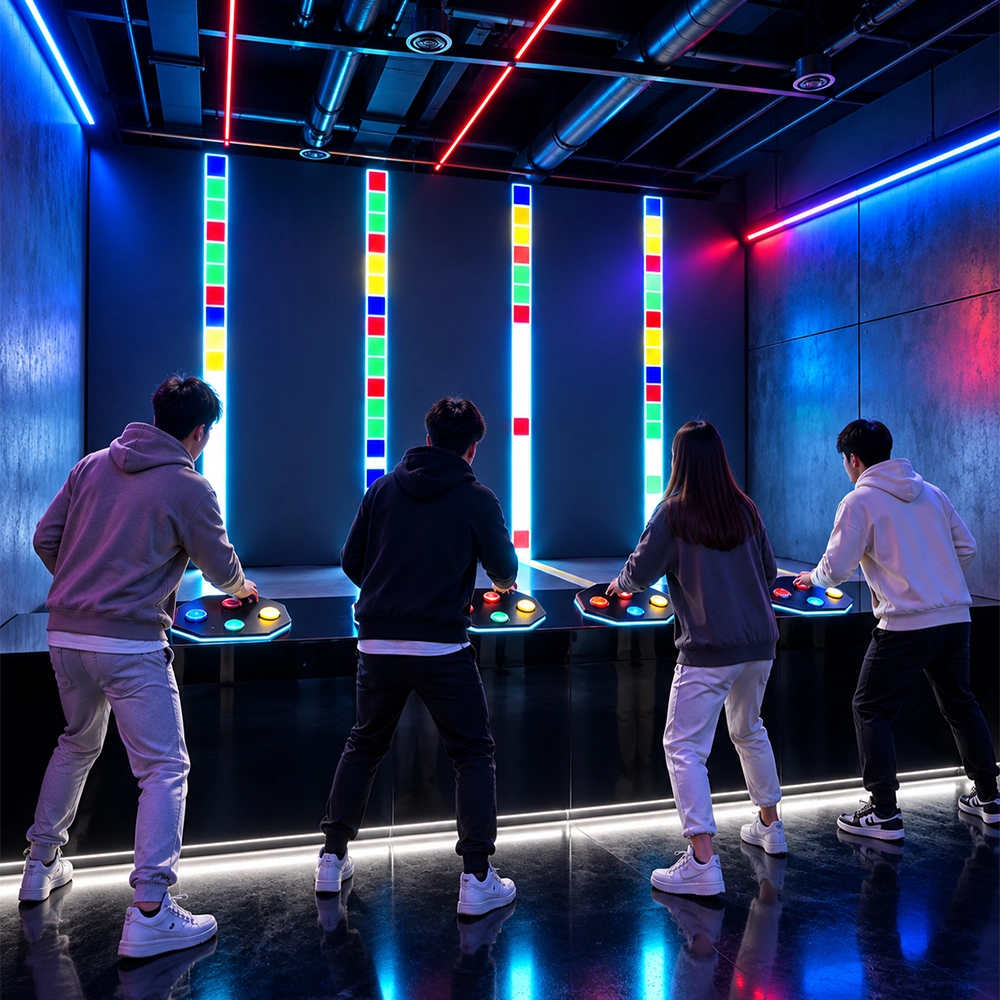
A practical room commonly includes four zones: an arrival and briefing area, a high-energy activity area, a skill or education area, and a flexible social area. The high-energy zone can host active reaction games, laser interactive game formats, or movement-based challenges. The skill zone can include memory, coordination, timing, and brain challenge content. The flexible zone can support seasonal themes, group competitions, birthday activities, or temporary promotional installations.
Visual zoning can be achieved through flooring colors, ceiling features, low partitions, branded graphics, lighting scenes, and sound direction rather than permanent walls. This approach preserves flexibility and helps staff supervise multiple attractions. Clear sightlines are particularly important when younger children use the facility or when a single attendant is responsible for several stations.
Choosing Equipment for Capacity, Safety, and Revenue
Match attraction formats to available space
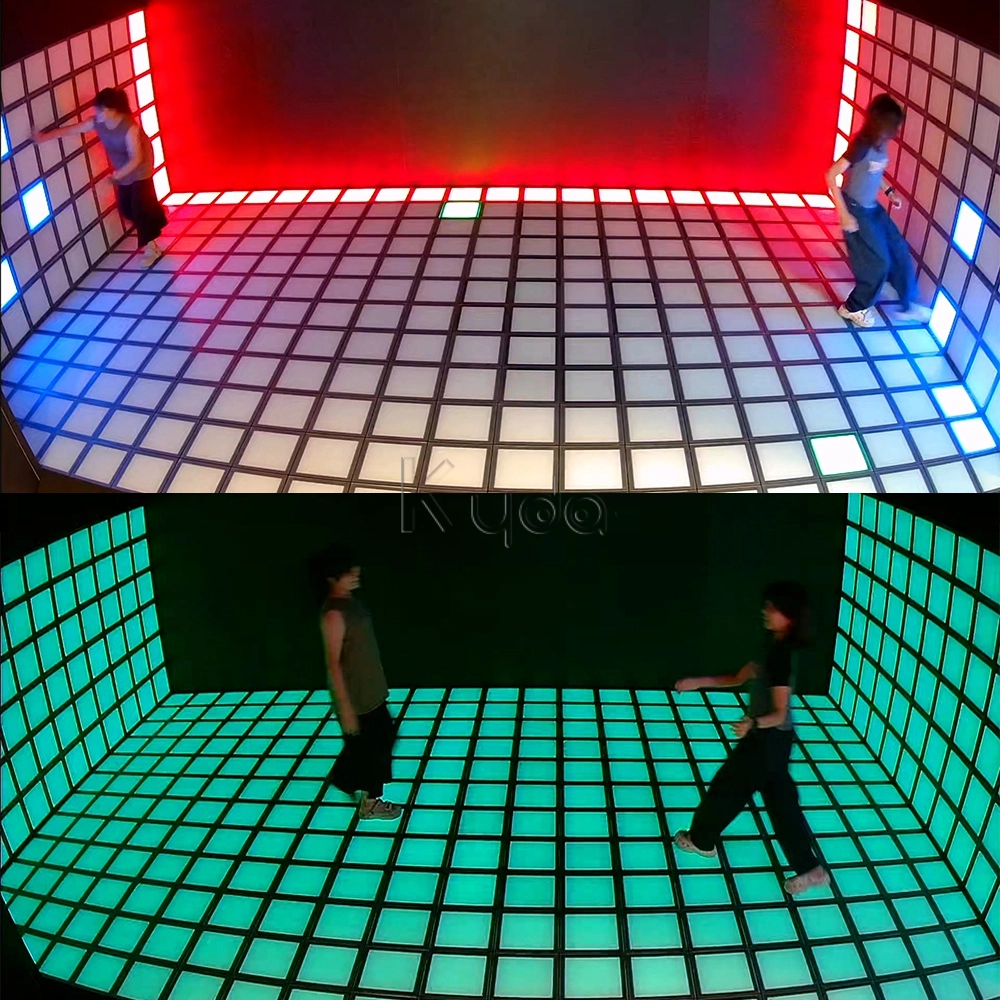
Different technologies solve different layout problems. Interactive projection games can transform a wall or floor into a responsive play surface and often support multiple themes through software updates. An interactive LED floor creates a durable, visually prominent attraction that can deliver reaction, balance, sports, and dance content. An interactive LED wall uses vertical space effectively and can be positioned in corridors, waiting zones, or compact challenge rooms. Laser-based attractions can create competitive team play, but they require careful control of visibility, boundaries, supervision, and equipment storage.
For smaller venues, modular attractions with short reset times and multiple game modes can provide better utilization than a single-purpose installation. For larger centers, a combination of anchor attractions and compact repeat-play stations can balance customer dwell time with hourly throughput. Buyers should request the recommended player count, play cycle, reset time, power demand, software update process, and service clearance for every proposed product.
Evaluate safety as a design system
Safety cannot be treated as a label applied after the layout is complete. It includes slip resistance, edge protection, impact zones, cable management, emergency stop access, heat dissipation, lighting levels, sound exposure, operator procedures, and age-appropriate instructions. The applicable building, electrical, fire, accessibility, and amusement requirements vary by country and venue type, so project owners should involve qualified local professionals before installation.
International buyers can use recognized frameworks as part of their due diligence. The ISO 9241-210 standard provides guidance on human-centred design, which is relevant when interfaces must be understandable for children, parents, and staff. Product-specific amusement requirements should also be reviewed with local authorities and qualified inspectors; the ASTM F1918 standard is one example of a recognized safety standard for soft contained play equipment, although it does not replace local compliance obligations.
Compare operating economics, not only purchase price
The lowest equipment quotation may not deliver the lowest total cost of ownership. Buyers should compare expected utilization, staffing, consumables, spare parts, warranty terms, software support, replacement modules, energy consumption, and downtime response. A product that can run several game modes may generate more repeat visits than a visually impressive but limited attraction. A supplier that provides installation drawings, training, remote diagnostics, and spare-part guidance can also reduce operational disruption.
| Equipment format | Space profile | Typical engagement model | Key procurement considerations |
|---|---|---|---|
| Interactive projection game | Flexible floor or wall zone with controlled projection distance | Solo, family, or group play with changeable content | Projector brightness, calibration, ambient light, software updates, and maintenance access |
| Interactive LED floor | Dedicated durable floor platform | Fast reaction, sports, dance, and movement challenges | Load rating, slip resistance, pixel protection, replacement modules, and cable routing |
| Interactive LED wall | Vertical feature wall or compact challenge zone | Touch, timing, visual reaction, and branded content | Viewing angle, impact protection, ventilation, content management, and wall structure |
| Laser interactive game | Open bounded area with defined player routes | Competitive team missions and repeat-play sessions | Safety procedures, equipment charging, supervision, boundary control, and maintenance |
Building a Reliable Project Specification
Prepare a technical brief for supplier comparison
A clear request for quotation should include floor plans, ceiling height, entrance dimensions, local voltage and frequency, climate conditions, target audience, operating hours, desired throughput, language requirements, branding guidelines, delivery destination, installation responsibility, and regulatory expectations. It should also state whether the buyer requires a complete room solution or individual products.
The technical brief should request drawings in usable formats, a bill of materials, power and data schedules, recommended network architecture, installation sequence, testing criteria, training scope, warranty exclusions, and a spare-parts list. This documentation enables apples-to-apples comparison among manufacturers and reduces the risk of hidden construction costs.
Plan technology infrastructure and content management
Interactive attractions depend on coordinated hardware and software. The project may require dedicated circuits, surge protection, wired network connections, ventilation, blackout treatment, speakers, amplifiers, media servers, sensors, and secure equipment cabinets. Network segmentation can help separate game systems from a venue’s business network, while controlled administrator access reduces the risk of unauthorized changes.
Content should be evaluated for replay value, cultural suitability, language localization, age appropriateness, and updateability. Operators should ask whether new games can be added remotely, whether branded content is available, and whether the system records useful operational metrics. Data collection must follow applicable privacy laws and venue policies; the ISO/IEC 27001 information security framework can provide useful reference points for organizations managing sensitive digital information, although certification is not automatically required for every entertainment project.
Validate installation, commissioning, and after-sales support
Commissioning should include physical inspection, software testing, calibration, sound checks, emergency procedures, multiplayer verification, network testing, and staff training. The handover package should contain operating manuals, preventive maintenance schedules, troubleshooting steps, warranty contacts, and a record of installed serial numbers. Buyers should also confirm how quickly technical support responds across time zones and whether replacement components are stocked locally or shipped internationally.
For imported equipment, the buyer should verify customs documentation, packaging standards, insurance responsibility, delivery terms, and onsite unloading requirements. International electrical compatibility and local certification must be confirmed before shipment rather than discovered during installation. This procurement discipline protects the launch schedule and prevents avoidable conversion or rebuilding costs.
Why Kyda Supports Customized Active Game Room Projects
One-stop development and manufacturing capability
Kyda is a one-stop solution provider for active game rooms and Activate gaming centers, covering custom research and development, production, sales, and project support. Our product portfolio includes active interactive games, interactive LED floor systems, active reaction games, brain challenge games, horror escape games, active fitness games, interactive projection games, and indoor and outdoor amusement equipment.
Our team combines electronic design and development, software programming, game design, animation design, product design, multimedia design, and interior design. This combination helps project owners coordinate the attraction, the digital experience, and the physical environment through one accountable development pathway. Instead of treating equipment as isolated items, our team can help align game mechanics, branding, circulation, room themes, and operational objectives.
Product selection for compact and high-utilization venues
Kyda solutions can be configured for different commercial formats, including family entertainment centers, shopping mall installations, resorts, educational venues, fitness spaces, and dedicated Activate gaming centers. Interactive projection games can support flexible content and multi-user play, while an interactive LED floor can serve as a highly visible anchor attraction. An interactive LED wall can use vertical real estate for reaction challenges and branded visual experiences. Laser interactive game systems can add competitive group play when the venue can provide appropriate boundaries and operating controls.
Our approach focuses on practical commercial value: strong visual attraction, repeatable gameplay, manageable staffing, customization potential, and a project configuration that matches the available footprint. Buyers can review the Solution options to identify a suitable direction before requesting a detailed proposal.
Manufacturing network and customization support
Kyda leverages manufacturing advantages in Guangzhou, Zhongshan, Zhengzhou, and Beijing, supported by long-term partnerships with LED light factories, advertising production factories, sheet metal factories, paint factories, electronic assembly factories, 3D plastic printing factories, and multimedia resource companies. This network helps our team coordinate customized products and complete projects for different local requirements, architectural conditions, and market preferences.
Customization may involve cabinet dimensions, colors, logos, game languages, content themes, control interfaces, room graphics, hardware integration, and attraction combinations. Our engineering and production process is designed to accommodate evolving technology and changing customer requirements while maintaining practical attention to assembly, testing, installation, and after-sales service. Kyda’s vision is to become the world’s leading active game room manufacturer, and our project approach is built around long-term product value rather than a one-time equipment transaction.
Procurement questions to ask Kyda before ordering
Project owners should provide the site plan, target customer profile, expected daily attendance, preferred attraction types, budget range, destination country, delivery timeline, and local compliance requirements. Kyda can then evaluate the space, recommend a product combination, define technical requirements, and clarify which elements are standard or customized.
Buyers should request a complete quotation that separates equipment, software, content customization, shipping, installation, training, spare parts, and optional services. This transparency supports financial modeling and makes it easier to compare the proposal with alternative suppliers. For project discussions, contact Kyda at sales@kydavr.com or review the product range at https://www.kydagames.com.
Frequently Asked Questions
How much space is needed for an active game room?
The required space depends on the attraction mix, player capacity, circulation routes, queue length, ceiling height, safety clearances, and maintenance access. Buyers should calculate the operational footprint rather than using only the physical equipment dimensions.
Which equipment is best for a small interactive game room?
Compact venues often benefit from modular interactive projection games, interactive LED wall systems, reaction challenges, and other multi-mode attractions that use vertical or flexible space and support short, repeatable play sessions.
How can an active game room improve visitor throughput?
Throughput can improve by combining short play cycles, multiple player positions, clear queues, fast resets, visible instructions, efficient staff sightlines, and attractions that support several users or game modes.
What should buyers check when selecting an interactive amusement equipment manufacturer?
Buyers should review technical drawings, safety and compliance documentation, software support, customization capability, warranty terms, spare-parts availability, installation procedures, training, response times, and total cost of ownership.
Can interactive game equipment be customized for a local market?
Yes. Customization may include cabinet dimensions, colors, logos, languages, game themes, room graphics, control interfaces, content, and attraction combinations, subject to technical feasibility and project requirements.
What infrastructure does an interactive game room require?
Depending on the equipment, the project may require dedicated electrical circuits, surge protection, wired network connections, ventilation, speakers, media servers, sensors, secure equipment cabinets, controlled lighting, and accessible maintenance routes.
Top activate game room Manufacturers and Suppliers
Interactive Wall Projection Games for Kids: Guide, Benefits, and Buying Tips
What Types of Interactive Game Room Equipment Are Available for Indoor Venues?
Everything You Need to Know About interactive wall projection games
You May Also Like
-
-
Send us Your Inquiry
-
Fill out the form and we will provide you with personalized product quotes and service recommendations based on your needs.
Our team will contact you as soon as possible to help you build the most suitable entertainment equipment!
Let's get in touch
Email: sales@kydavr.com
Tel.: +86 188 2001 8779
Address: 501 Shixin Road, Dalong Street, Guangzhou, Guangdong, China.
© 2025 Kyda. All Rights Reserved.
 Scan QR Code
Linkedin
Ins
Facebook
Twitter
YouTube